
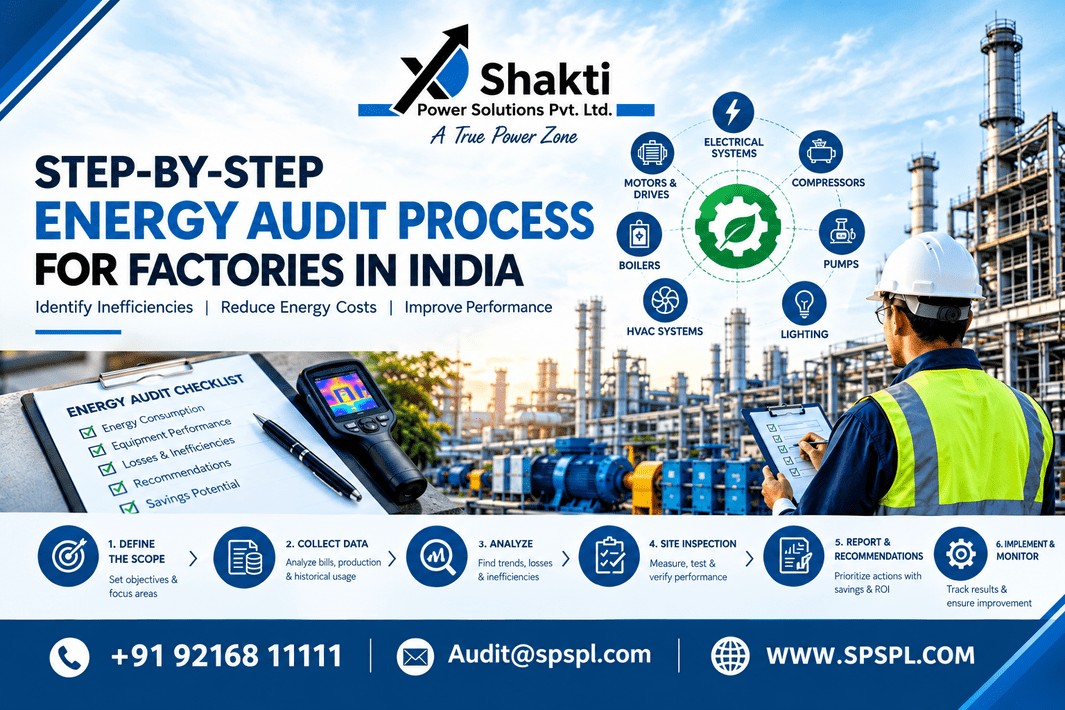
A factory can consume thousands of units of electricity every day, but simply looking at the monthly electricity bill does not tell you where that energy is going.
Motors may be running below their optimum load. Compressed-air systems may have leaks. Pumps and fans may be operating at higher capacity than necessary. Heat may be escaping from poorly insulated systems. At the same time, equipment may continue running even when production demand is low.
These small inefficiencies can add up to significant operating costs over time.
This is why understanding the energy audit process for factories in India is important for businesses that want to improve energy efficiency, control operating costs and make better decisions about their industrial systems.
An energy audit provides a structured way to understand how energy is purchased, distributed and consumed within a factory. More importantly, it helps identify practical opportunities to reduce unnecessary energy consumption without compromising production.
In this article, we will explain the complete energy audit process for factories, from initial data collection and site inspection to identifying energy-saving opportunities, calculating potential savings and monitoring the results.
Table of Contents
What Is an Energy Audit?
An energy audit is a systematic assessment of energy use within a facility.
In simple terms, it answers three important questions:
- Where is the factory using energy?
- Where is energy being wasted or used inefficiently?
- What can be done to improve energy performance?
During an industrial energy audit, an auditor studies energy bills, production data, equipment information and operating conditions. Depending on the scope of the audit, actual measurements may also be taken from electrical and mechanical systems.
Commonly assessed systems include:
- Motors and drives
- Compressors
- Pumps
- Fans
- Boilers
- Furnaces
- HVAC systems
- Transformers
- Lighting
- DG sets
- Production equipment
- Electrical distribution systems
The objective is not simply to find problems. A useful audit should connect each major finding with a practical recommendation and, where possible, an estimate of energy savings, investment and payback.
What Is an Energy Audit and Why Is It Important for Indian Industries?
Why Is an Energy Audit Important for Factories?
Energy is an important operating cost for many manufacturing facilities. When equipment operates for long hours, even a relatively small efficiency problem can become expensive over a year.
For example, imagine a motor that operates for several thousand hours annually. If the motor is incorrectly sized, poorly maintained or operating inefficiently, the additional electricity consumption continues every time the machine runs.
An energy audit helps identify these hidden inefficiencies.
1. Identifies Energy Wastage
The audit helps locate areas where energy is being consumed unnecessarily or where equipment is not operating efficiently.
2. Helps Reduce Operating Costs
Reducing unnecessary electricity or fuel consumption can directly contribute to lower operating expenses.
3. Improves Equipment Performance
Measurements can reveal problems such as poor loading, excessive pressure, voltage imbalance, inefficient operation or abnormal energy consumption.
4. Supports Better Investment Decisions
Instead of selecting energy-saving equipment based only on assumptions, management can use measured data and estimated savings to evaluate potential projects.
5. Creates a Baseline for Improvement
A proper audit establishes a picture of current energy performance. This baseline can then be used to measure future improvements.
A systematic approach to energy management is also consistent with the principles behind ISO 50001, which provides a framework for improving energy performance through measurement, monitoring and continual improvement.]
Step-by-Step Energy Audit Process for Factories in India
A professional audit follows a structured process rather than simply walking through the factory and making observations.
The exact scope can vary depending on the size, industry and complexity of the facility, but the following steps provide a practical framework.
Step 1 – Define the Scope of the Energy Audit
Before collecting data or taking measurements, the scope of the audit needs to be clearly defined.
A factory may contain several production lines, buildings, utility systems and energy sources. Auditing every system in the same level of detail may not always be necessary.
The scope can be based on:
- Factory size
- Production processes
- Energy consumption
- Major energy-consuming equipment
- Previous energy performance
- Specific problems identified by management
- Expected savings opportunities
The audit team should also establish clear objectives.
For example, a factory may want to:
- Reduce electricity consumption
- Reduce maximum demand
- Improve power factor
- Reduce compressed-air losses
- Improve motor efficiency
- Reduce fuel consumption
- Improve overall energy performance
A clearly defined scope keeps the energy audit process focused and makes the final recommendations more useful.
Step 2 – Collect Energy and Production Data
Once the scope is defined, historical information is collected.
This is one of the most important stages because the auditor needs to understand the factory’s energy pattern before arriving at the site.
Useful information may include:
- Electricity bills
- Monthly energy consumption
- Maximum demand
- Power factor
- Electricity tariff
- Production quantity
- Operating hours
- Fuel consumption
- DG set operation
- Equipment ratings
- Maintenance records
- Previous energy audit reports
Where possible, data from around 12 months should be reviewed so that seasonal changes can be considered.
Production data is particularly important.
Suppose electricity consumption increased by 8% compared with the previous year. That does not automatically mean the factory became less efficient. Production may also have increased.
For this reason, energy consumption is often evaluated against production output.
For example:
Energy Performance = Energy Consumption ÷ Production Output
A measure such as kWh per tonne of product can provide a more meaningful indication of energy performance than total electricity consumption alone.
Industrial Energy & Power Quality Audit Services in India
Step 3 – Review Electricity Bills and Energy Consumption
The next step is to examine the factory’s electricity consumption pattern.
Electricity bills can provide useful information about:
- Total energy consumption
- Maximum demand
- Contract demand
- Power factor
- Electricity tariff
- Monthly variations
- Demand-related charges
- Energy costs
The objective is to identify unusual patterns that require further investigation.
For example, if production remains relatively stable while electricity consumption continues to increase, there may be an underlying efficiency issue.
Similarly, consistently high maximum demand may indicate an opportunity to review load management.
The bill itself does not tell the complete story, but it provides a valuable starting point for the audit.
Step 4 – Conduct a Preliminary Site Survey
After reviewing the available data, the audit team visits the factory.
The preliminary site survey helps the auditor understand how the facility actually operates.
Typical areas inspected include:
- Production floors
- Electrical rooms
- Compressor rooms
- Boiler rooms
- Pumping systems
- HVAC areas
- Utility sections
- DG set areas
- Lighting systems
The auditor observes equipment condition, operating practices and possible sources of energy loss.
Talking to machine operators can also be extremely useful.
Operators often know about issues that may not be obvious from energy bills, such as:
- Frequent equipment breakdowns
- Air leaks
- Pressure problems
- Equipment overheating
- Machines running unnecessarily
- Production-related operating changes
Combining technical measurements with practical knowledge from the plant team can make the audit much more effective.
Step 5 – Identify Major Energy-Consuming Equipment
Not every piece of equipment contributes equally to total energy consumption.
The audit therefore focuses attention on major energy-consuming systems.
Motors and Drives
Motors are widely used throughout industrial facilities.
The auditor may evaluate motor loading, operating hours, efficiency and whether the selected motor is appropriate for the application.
Compressed-Air Systems
Compressed air can be an expensive utility when the system is poorly maintained.
Common issues include:
- Air leaks
- Excessive pressure
- Unnecessary use
- Poor compressor loading
- Improper system design
Pumps and Fans
Pumps and fans may operate continuously in manufacturing facilities.
Their performance should be assessed based on actual flow, pressure, operating requirements and control methods.
Boilers and Furnaces
Thermal systems should be examined for fuel consumption, combustion performance, insulation and heat losses.
HVAC and Cooling Systems
HVAC and process cooling can become significant energy consumers, particularly in facilities operating for long hours.
Lighting Systems
Lighting should be evaluated for efficiency, operating schedules and unnecessary usage.
Step 6 – Measure and Monitor Energy Performance
Observation alone is not enough for a detailed audit.
Actual measurements help determine how equipment performs under real operating conditions.
Depending on the system, measurements may include:
- Voltage
- Current
- Power
- Power factor
- Energy consumption
- Temperature
- Pressure
- Flow
- Humidity
- Fuel consumption
- Compressed-air parameters
For electrical systems, appropriate power-monitoring instruments can be used to assess electrical performance.
For thermal systems, temperature and combustion-related measurements may be required.
The objective is to move from assumptions to measurable evidence.
This is particularly important when calculating potential savings because recommendations should be based on the actual operating condition of the factory.
Step 7 – Identify Energy Losses and Inefficiencies
After collecting measurements, the results are analyzed.
The auditor compares actual performance with expected operating conditions and identifies areas where energy may be unnecessarily consumed.
Common findings can include:
- Poorly loaded motors
- Compressed-air leakage
- Excessive compressor pressure
- Poor insulation
- Inefficient lighting
- Equipment running during idle periods
- Pump and fan throttling losses
- Heat losses
- Poor power factor
- Voltage imbalance
- Electrical system losses
- Inefficient operating practices
However, not every finding deserves the same priority.
A good audit ranks opportunities according to factors such as:
- Expected energy savings
- Financial savings
- Investment required
- Payback period
- Production impact
- Ease of implementation
This helps management focus on measures that can provide the greatest practical benefit.
Step 8 – Develop Energy-Saving Opportunities
Once inefficiencies have been identified, the next stage is to develop practical energy conservation measures.
Depending on the factory, recommendations may include:
- Repairing compressed-air leaks
- Optimizing compressor pressure
- Installing variable frequency drives where appropriate
- Replacing inefficient motors
- Improving insulation
- Optimizing pumps and fans
- Improving lighting controls
- Optimizing HVAC operation
- Improving power factor
- Reducing unnecessary equipment idling
- Improving preventive maintenance
- Recovering waste heat where technically feasible
The key word here is appropriate.
Not every energy-saving technology is suitable for every factory.
A recommendation should consider the actual production process, operating hours, equipment condition and financial feasibility.
Step 9 – Calculate Energy Savings, Investment and Payback
An energy-saving recommendation becomes much more useful when its financial impact is clearly understood.
For each major opportunity, the auditor can estimate:
Energy Savings → Cost Savings → Investment → Payback
For example, if a proposed improvement is expected to save 40,000 kWh per year, the annual monetary saving can be estimated using the applicable electricity cost.
The investment can then be compared with the expected annual saving.
A simple payback calculation is:
Payback Period = Investment Cost ÷ Annual Cost Savings
This allows factory management to compare different opportunities.
Some measures may require almost no capital investment and provide quick savings. Others may require a larger investment but deliver greater savings over the long term.
Step 10 – Prepare the Energy Audit Report
The findings are documented in an energy audit report.
A useful report generally includes:
- Executive summary
- Factory overview
- Energy consumption analysis
- Production analysis
- Energy performance indicators
- Major energy-consuming systems
- Measurement results
- Identified inefficiencies
- Recommended energy-saving measures
- Estimated energy savings
- Estimated financial savings
- Investment requirements
- Payback period
- Implementation priorities
The report should not simply contain pages of technical data.
Management should be able to understand:
What is the problem?
Why is it happening?
What should be done?
How much could it save?
What will it cost to implement?
That is what turns an audit report into a useful decision-making document.
Step 11 – Implement the Recommended Measures
An energy audit creates value only when its recommendations are implemented.
Factories can prioritize recommendations according to:
- Investment required
- Expected savings
- Payback period
- Production impact
- Maintenance requirements
- Technical feasibility
- Implementation complexity
A practical approach is to begin with low-cost or no-cost opportunities.
For example, correcting operating practices, eliminating unnecessary equipment running time or repairing compressed-air leaks may require relatively little investment.
Larger projects can then be evaluated using a proper financial and technical analysis.
Implementation should involve relevant teams such as:
- Production
- Maintenance
- Electrical
- Utilities
- Engineering
- Management
Energy efficiency works best when it becomes a shared responsibility rather than the responsibility of only one department.
Step 12 – Monitor the Results After Implementation
This is the step that is sometimes forgotten.
After implementing an energy-saving measure, the factory should monitor whether the expected improvement is actually being achieved.
Simply comparing two electricity bills may not be enough.
For example, if production increased significantly after an energy-saving project, total electricity consumption could increase even though efficiency improved.
Instead, management can track an energy performance indicator such as:
kWh per tonne of production
Regular monitoring helps answer an important question:
Did the implemented measure actually improve energy performance?
Monitoring also helps identify new inefficiencies and ensures that savings are maintained over time.
Common Areas Checked During a Factory Energy Audit
The scope of an energy audit for factories varies according to the facility, but several systems commonly deserve attention.
| System | Typical Parameters / Areas Checked |
|---|---|
| Electrical system | Voltage, current, power factor, demand and losses |
| Motors | Loading, efficiency and operating hours |
| Compressors | Pressure, loading, leakage and demand |
| Pumps | Flow, pressure and operating efficiency |
| Fans | Airflow, pressure and operating conditions |
| Boilers | Fuel consumption, combustion and heat losses |
| Furnaces | Fuel use, temperature and insulation |
| HVAC | Temperature, operating hours and system efficiency |
| Lighting | Efficiency, controls and operating schedule |
| Transformers | Loading and losses |
| DG sets | Fuel consumption and loading |
| Production equipment | Operating practices and energy consumption |
What Data Is Required for an Industrial Energy Audit?
Good-quality data makes the audit more accurate.
Before the audit, factories should ideally keep the following information ready:
- Electricity bills
- Production records
- Fuel consumption records
- Equipment list
- Motor ratings
- Compressor specifications
- Boiler information
- Furnace information
- Operating hours
- Maintenance records
- Previous audit reports
- Utility system data
The auditor can use this information to establish a baseline and identify unusual consumption patterns.
In addition to historical records, actual measurements from the factory are important for validating assumptions.
Common Energy-Saving Opportunities in Factories
Energy-saving opportunities are different for every plant, but certain areas repeatedly deserve attention.
Compressed Air
Look for leaks, unnecessarily high pressure and inappropriate compressed-air applications.
Motors
Review motor loading, efficiency and operating conditions before deciding whether replacement or speed control is justified.
Pumps and Fans
Check whether flow and pressure requirements are being met efficiently and whether the control method is suitable.
Lighting
Improve lighting efficiency and use controls where operating schedules allow it.
HVAC
Review temperature settings, maintenance, operating schedules and system performance.
Electrical Systems
Monitor power factor, demand, loading and electrical performance.
Thermal Systems
Inspect insulation, combustion efficiency and heat losses.
Operating Practices
Avoid unnecessary idling and make sure equipment is not operating when it is not required.
In many factories, the most effective approach is not one large project but a combination of several improvements.
Is Energy Audit Mandatory for Factories in India?
This is an important question, and the answer depends on the facility and its regulatory classification.
India’s Bureau of Energy Efficiency (BEE) identifies certain energy-intensive industries as Designated Consumers under the Energy Conservation framework. These include sectors such as aluminium, cement, chlor-alkali, fertiliser, iron and steel, pulp and paper, railways, thermal power and textiles. BEE also provides regulations and notifications relating to energy audits and designated consumers.
Therefore, factories should not assume that the same audit requirement applies to every industrial facility. The applicable requirements should be checked based on the facility, sector and current regulations.
How Much Can a Factory Save Through an Energy Audit?
There is no universal percentage that can be applied to every factory.
The potential savings depend on:
- Existing equipment efficiency
- Operating hours
- Electricity tariff
- Production process
- Maintenance practices
- Age of equipment
- Utility system design
- Existing energy-management practices
A factory with highly optimized systems may have fewer low-cost opportunities.
Another facility with significant inefficiencies may have much greater potential.
This is why it is better to measure first and estimate savings based on actual operating conditions rather than promising a fixed percentage of savings.
Energy Audit vs Energy Management: What’s the Difference?
An energy audit is an assessment. Energy management is an ongoing process.
Think of an audit as a health check of the factory’s energy systems.
The audit identifies problems and opportunities. Energy management ensures that improvements are implemented, measured and maintained.
A strong energy-management approach can include:
- Regular energy monitoring
- Energy performance indicators
- Energy baselines
- Preventive maintenance
- Energy-saving targets
- Employee awareness
- Periodic reviews
- Continuous improvement
ISO 50001 provides a structured framework for organizations that want to establish, maintain and continually improve an energy management system.
Energy Audit vs Power Quality Audit – Key Differences for Indian Industries
Frequently Asked Questions About Energy Audits
1. What is the energy audit process for factories in India?
The process generally includes defining the audit scope, collecting energy and production data, reviewing consumption patterns, conducting a site survey, measuring major energy-consuming systems, identifying inefficiencies, developing energy-saving opportunities, calculating potential savings and preparing an audit report.
2. How is an energy audit conducted in a factory?
An auditor first reviews historical energy and production data. A site inspection is then conducted to understand the factory’s systems and operating practices. Major energy-consuming equipment is measured and analyzed to identify inefficiencies and potential improvement opportunities.
3. How long does a factory energy audit take?
The duration depends on the factory’s size, production processes, number of energy-consuming systems and the scope of the assessment. A small facility may require a relatively simple assessment, while a large manufacturing plant may need a more detailed audit.
4. What equipment is checked during an energy audit?
Depending on the facility, the audit may include motors, compressors, pumps, fans, boilers, furnaces, HVAC systems, transformers, lighting systems, DG sets and production equipment.
5. Is an energy audit mandatory for factories in India?
Not every factory is subject to the same requirement. Certain energy-intensive sectors and designated consumers are covered by specific requirements under India’s energy-conservation framework. Factories should check the current BEE requirements applicable to their facility.
6. How can an energy audit reduce factory electricity costs?
An audit identifies inefficient equipment, energy losses and unnecessary consumption. Suitable measures can then be implemented to reduce energy use, improve equipment performance and lower electricity-related operating costs.
7. What is the difference between an energy audit and an energy management system?
An energy audit evaluates current energy performance and identifies improvement opportunities. An energy management system provides an ongoing framework for managing, measuring and continually improving energy performance.
8. What information should a factory provide before an energy audit?
Useful information includes electricity bills, production data, equipment lists, operating hours, fuel consumption, equipment ratings, maintenance records and previous audit reports.
Conclusion
The energy audit process for factories in India provides a structured way to understand where energy is being consumed and where improvements can be made.
From defining the audit scope and collecting historical data to conducting site inspections, measuring equipment performance and calculating potential savings, every stage contributes to a clearer understanding of the factory’s energy performance.
But the real value of an audit comes after the report is completed.
Recommendations need to be prioritized, implemented and monitored. When energy efficiency becomes part of regular plant management, factories can make better use of their equipment, reduce avoidable energy consumption and make more informed investment decisions.
For factories dealing with rising operating costs and increasing pressure to improve efficiency, a professional industrial energy audit can be a practical first step.
The first step toward reducing energy waste is understanding where that energy is being used.