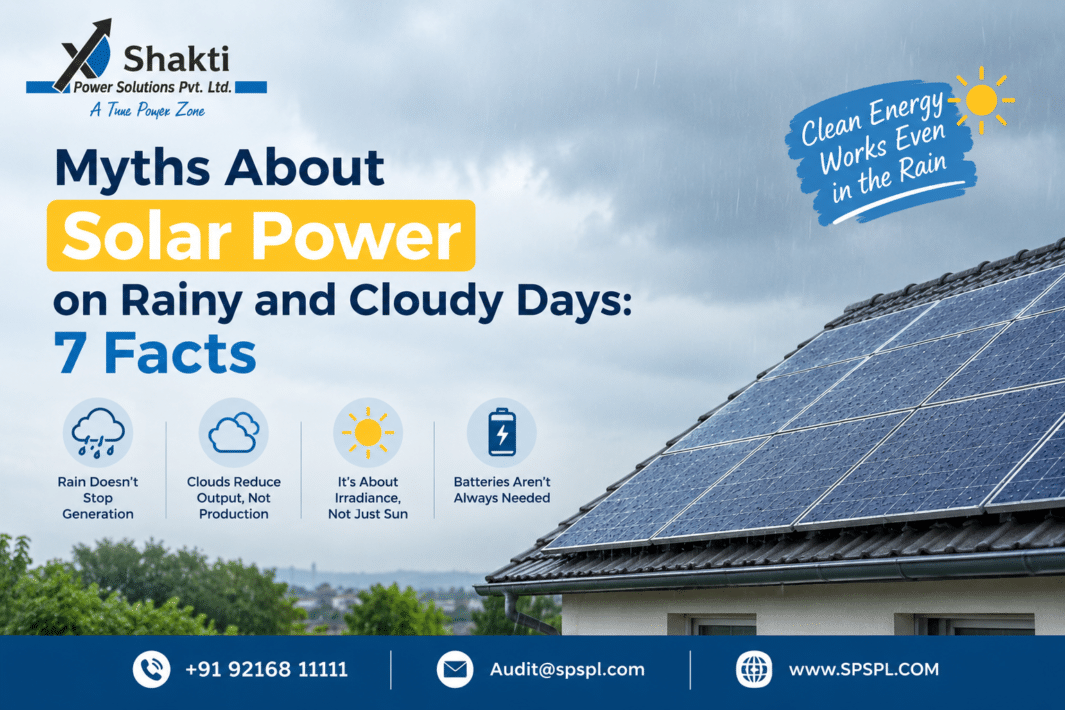
Myths About Solar Power on Rainy and Cloudy Days are common among homeowners, businesses, students, and people considering solar for the first time. Many people believe that solar panels only work when the sky is bright and clear. Others assume that rain completely stops electricity generation, that a 10 kW solar system produces 10 kW all day, or that batteries are always necessary during cloudy weather.
These assumptions sound reasonable, but solar PV systems do not work quite that way.
Solar panels convert available solar radiation into electricity. That radiation can reach the panels as direct sunlight as well as diffuse sunlight scattered by the atmosphere and clouds. When cloud cover becomes heavier, the available solar radiation usually falls, so electricity generation can also decrease. However, cloudy weather does not automatically mean that a solar system stops producing electricity.
In this article, we will break down 7 common Myths About Solar Power on Rainy and Cloudy Days and explain what actually happens to solar generation.
Table of Contents
Myth 1: Solar Panels Need Bright Sunshine to Work
One of the biggest Myths About Solar Power on Rainy and Cloudy Days is that solar panels need bright, direct sunshine before they can generate electricity.
The fact: Solar panels can use both direct and diffuse sunlight.
Photovoltaic panels respond to sunlight reaching their surface. On a clear day, a large portion of that radiation arrives as direct beam radiation.
When clouds, water vapour, dust, or other atmospheric particles scatter sunlight, some of the radiation becomes diffuse solar radiation.
That means the sky does not have to look perfectly blue for a PV system to produce electricity.
The U.S. Department of Energy explains that solar radiation reaching the Earth’s surface includes both direct and diffuse radiation. Under thick cloud cover, direct beam radiation can fall substantially, but diffuse radiation can still reach the surface.
This is one reason why a solar panel can continue generating electricity on an overcast day.
However, there is an important difference between working and producing at the same level.
A solar panel can work on a cloudy day while producing much less power than it would under strong sunlight.
So:
Cloudy weather ≠ zero generation.
It usually means:
Less available solar radiation → lower PV output.
If you want a more detailed explanation of this topic, see our pillar guide: [Solar Panels on Cloudy Days: Do They Really ].
Myth 2: Rain Completely Stops Solar Power Generation
Another common belief among the Myths About Solar Power on Rainy and Cloudy Days is that rain automatically switches a solar system off.
The fact: Rain can reduce solar output, but it does not automatically stop generation.
The key factor is not simply whether rain is falling.
The more important question is:
How much solar radiation is reaching the solar panels?
A light rain shower with bright or partly cloudy conditions may still allow a PV system to generate electricity.
During a heavy storm, however, thick clouds can block or scatter much of the incoming solar radiation. As a result, the system’s output may fall considerably.
The U.S. Department of Energy notes that solar production can be affected by conditions including clouds, rain, dust, haze, shadows, and other obstructions.
This means rain and clouds can affect solar generation, but they should not be treated as an on/off switch.
What happens during heavy rain?
A typical pattern can look like this:
- Clear sky → higher solar output
- Light cloud cover → moderate reduction
- Heavy cloud cover → larger reduction
- Heavy rain and dense clouds → potentially very low output
The actual result depends on the site, weather conditions, system design, and amount of solar radiation available.
So the simple statement “rain stops solar power” is misleading.
The more accurate statement is:
Rainy weather can reduce solar generation when it reduces the amount of solar radiation reaching the PV system.
Myth 3: A 10 kW Solar System Produces 10 kW All Day
This is one of the most important Myths About Solar Power on Rainy and Cloudy Days for new solar buyers.
Someone may see “10 kW solar system” and assume that the plant will continuously generate 10 kW.
The fact: 10 kW is the system’s rated capacity, not its constant daily output.
Solar PV systems do not normally produce their rated capacity every hour of the day.
Solar generation changes with:
- Time of day
- Solar irradiance
- Cloud cover
- Temperature
- Panel orientation
- Shading
- System losses
- Inverter performance
- Equipment availability
A 10 kW system can therefore produce different amounts of power at different times.
For example, output will normally be lower in the early morning and late afternoon than around the strongest solar hours. Cloud cover can reduce output further.
This is why power capacity and energy generation should not be confused.
Power capacity vs energy generation
kW tells you about power capacity at a particular moment.
kWh tells you how much electrical energy is generated or consumed over a period.
For example, saying that a project has a 10 kW capacity does not tell you exactly how many kWh it will generate in a month.
For commercial and industrial buyers, expected monthly and annual energy generation is therefore often much more useful than the capacity number alone.
The U.S. Department of Energy explains that PV performance depends on operating conditions and that module ratings are determined under standardized test conditions rather than representing constant real-world output.
Myth 4: Solar Panels Perform Poorly All Winter
Many people assume that winter automatically makes solar panels ineffective. This is another important example of Myths About Solar Power on Rainy and Cloudy Days.
The fact: Winter generation can change, but solar panels continue to operate.
Winter can affect solar generation in several ways.
Depending on the location, winter may bring:
- Shorter daylight hours
- A lower sun angle
- More cloud cover
- Different temperatures
- Seasonal changes in solar radiation
These factors can influence the total energy a solar system generates.
However, it is incorrect to assume that solar panels simply stop working because temperatures fall.
In fact, PV cells generally perform well at lower temperatures. The U.S. Department of Energy explains that temperature affects PV efficiency and that higher temperatures can reduce voltage and overall cell performance.
This creates an important distinction:
Winter weather can affect total solar generation, but cold weather itself does not make PV technology useless.
A solar project should therefore be evaluated using location-specific solar-resource and weather data rather than assumptions about summer and winter alone.
What should a solar buyer check?
Instead of asking:
“Will solar work in winter?”
Ask:
“How much electricity is the system expected to generate at this location during each month of the year?”
That question produces a much more useful answer for project planning.
Myth 5: Every Solar Plant Produces the Same Amount of Electricity in Cloudy Weather
Another common misunderstanding in Myths About Solar Power on Rainy and Cloudy Days is that two solar plants with the same capacity should always produce the same amount of electricity.
The fact: Solar output can vary significantly between plants.
Imagine two solar plants.
Both have a rated capacity of 1 MW.
That does not mean both plants will necessarily produce the same amount of electricity every day or every year.
Their generation can differ because of:
- Location
- Solar resource
- Local weather
- Panel orientation
- Panel tilt
- Shading
- Module characteristics
- Inverter configuration
- Soiling
- Temperature
- Electrical losses
- System availability
- Maintenance
For example, a plant located in an area with stronger solar resources may have a different annual generation profile from an identical-capacity plant located elsewhere.
Cloud patterns can also differ from one location to another.
This is why a solar project should not be evaluated only by asking:
“How many MW is the plant?”
A better question is:
“How many MWh or kWh is the plant expected to generate?”
Capacity describes the size of the system.
Energy yield describes how much electricity that system actually produces over time.
That difference is especially important for businesses making long-term energy and investment decisions.
Myth 6: Cloudy Weather Makes Solar Generation Impossible to Predict
Among the Myths About Solar Power on Rainy and Cloudy Days, this one is particularly relevant for commercial and industrial solar projects.
Some people believe that if clouds can move across a solar plant, there is no practical way to estimate or manage solar generation.
The fact: Cloud cover creates variability, but solar generation can still be modelled and monitored.
Clouds can cause solar output to change quickly.
A cloud passing over a section of a solar array can temporarily reduce the amount of sunlight reaching the modules. When the cloud moves away, output can increase again.
This means solar generation is variable.
But variable does not mean impossible to understand.
Solar projects can use:
- Historical solar-resource information
- Weather data
- System-performance models
- Site characteristics
- Generation monitoring
- Historical plant data
- Solar forecasting techniques
The U.S. Department of Energy discusses the variability of solar generation and the role of forecasting, system planning, and storage in managing changing solar output.
For a business evaluating solar, the more useful question is not:
“Can anyone predict every cloudy minute perfectly?”
Instead, ask:
“Has the expected generation for this site been properly estimated across the year?”
That is a much more practical way to evaluate a solar project.
Myth 7: You Always Need a Battery When the Weather Is Cloudy
The final point in our Myths About Solar Power on Rainy and Cloudy Days is the assumption that every solar installation automatically needs batteries because clouds can reduce production.
The fact: Batteries can help, but they are not automatically required.
A battery does not make a solar panel produce more electricity from clouds.
Instead, a battery stores electricity generated earlier so that it can be used later.
For example, solar production may be high during the middle of the day while electricity demand is higher in the evening.
A battery can help shift some of that energy from the time it is generated to the time it is needed.
The U.S. Department of Energy explains that energy storage can help manage variations in solar generation and can support electricity use when solar production is low.
Storage can also help with short-term fluctuations caused by passing clouds.
When can batteries be useful?
A solar-plus-storage system may be considered when a project needs:
- Backup power
- Greater energy resilience
- Better alignment between generation and consumption
- Short-term output smoothing
- Greater control over stored energy
- Support during grid interruptions
But a battery should not be added simply because the weather can become cloudy.
The right decision depends on the project’s:
- Electricity demand
- Load profile
- Operating hours
- Grid connection
- Tariff structure
- Backup requirements
- Financial objectives
- Required level of energy resilience
So the better question is not:
“Do cloudy days mean I need a battery?”
It is:
“Would energy storage provide a useful benefit for this particular site?”
What These Myths Tell Us About Solar Performance
After looking at all seven Myths About Solar Power on Rainy and Cloudy Days, one idea becomes clear:
Solar power is not simply an ON/OFF system controlled by the weather.
The amount of electricity generated depends on the solar radiation reaching the PV system and the conditions under which the system operates.
Clouds can reduce solar irradiance.
Rain can reduce available sunlight.
Temperature can affect module performance.
Shading can reduce output.
Orientation and system design can influence how much sunlight the panels receive.
The result is a constantly changing generation profile.
That is completely normal for a solar PV system.
Why One Cloudy Day Should Not Decide Whether Solar Is Worth It
One of the biggest mistakes a new solar buyer can make is judging a system from a single day.
Imagine that a solar plant produces less electricity today because thick clouds cover the site.
That does not tell you how much electricity the plant will generate over:
- A month
- A season
- A year
- Its operating lifetime
Solar projects should be evaluated over longer periods.
A proper assessment can consider expected monthly generation, annual energy yield, solar-resource conditions, system losses, shading, equipment performance, and site characteristics.
This is particularly important for commercial and industrial buyers.
A factory, warehouse, hospital, office building, or institution may have a specific electricity-consumption pattern. The value of a solar installation depends not only on how much electricity the system can generate, but also on how that generation matches the site’s demand.
How Can You Estimate Solar Generation for Your Site?
If you are planning a solar project, avoid relying only on generic statements such as “solar works only in sunshine.”
A site-specific assessment is much more useful.
Depending on the project, the assessment may consider:
- Location
- Solar-resource data
- Roof or land availability
- Panel orientation
- Panel tilt
- Shading
- Module selection
- Inverter configuration
- Expected system losses
- Monthly generation
- Annual energy yield
- Electricity consumption
- Operating hours
- Maintenance requirements
Tools such as NREL’s PVWatts Calculator can be used to estimate the energy production of grid-connected PV systems using inputs such as system size, module type, array configuration, tilt, azimuth, and system losses.
For a commercial project, however, a generic calculator is only one part of the assessment. Site-specific engineering and actual project requirements also matter.
If you are exploring solar rooftop solutions, you can also review the available solar solutions from SPSPL before discussing your site requirements.
Why Real-World Solar Output Is More Important Than Rated Capacity
A solar module or plant can have an impressive rated capacity, but capacity alone does not tell the complete performance story.
Think about it this way:
Rated capacity = how large the system is
Energy yield = how much electricity the system produces
A good solar evaluation considers both.
It also considers the conditions that can influence actual generation.
This is why professional solar planning focuses on expected generation rather than promising that a system will produce its maximum rated output throughout the day.
The same principle applies to cloudy weather.
A cloudy day may reduce production.
A sunny day may increase production.
But neither day by itself tells you the full story of the project.
Frequently Asked Questions
Do solar panels work on cloudy days?
Yes. Solar panels can continue generating electricity under cloudy conditions because diffuse sunlight can still reach the PV modules. However, output is generally lower when solar irradiance is lower.
Do solar panels work when it rains?
Yes. Solar panels can generate electricity during rain when sufficient solar radiation reaches the system. Heavy rain and thick cloud cover can reduce output significantly.
Does a 10 kW solar system produce 10 kW all day?
No. A 10 kW rating represents the system’s rated power capacity under specified conditions. Actual output changes with sunlight, time of day, temperature, shading, system losses, and other factors.
Do solar panels work during winter?
Yes. Solar panels continue to operate in winter. Total generation can change because of daylight hours, solar angle, weather, temperature, and other site conditions.
Does cloud cover completely stop solar generation?
Not necessarily. Cloud cover can reduce the amount of solar radiation reaching the panels, but diffuse radiation can still reach the system.
Do cloudy days mean I need solar batteries?
Not automatically. Batteries can store solar electricity and help shift energy to periods when it is needed. Whether storage is useful depends on the site’s electricity demand, grid conditions, backup requirements, and project objectives.
Why can two solar plants with the same capacity produce different amounts of electricity?
Because generation depends on location, solar resource, weather, orientation, shading, equipment, system losses, availability, and other operating conditions.
What is the best way to evaluate a solar project?
Look beyond the rated capacity. Review expected monthly and annual energy generation, site conditions, electricity demand, system design, expected losses, and long-term performance assumptions.
Final Thoughts
The biggest lesson from Myths About Solar Power on Rainy and Cloudy Days is simple: cloudy or rainy weather does not automatically make solar power useless.
Solar panels can use available direct and diffuse solar radiation. Cloud cover and rain can reduce the amount of energy reaching the system, but the effect depends on the severity of the weather and the characteristics of the installation.
A 10 kW system does not produce 10 kW every hour. Winter does not automatically make solar ineffective. Two plants with the same capacity do not necessarily produce the same amount of electricity. And batteries are not automatically required just because clouds can reduce solar output.
For homeowners, businesses, students, and new solar buyers, the better approach is to look at expected energy generation over time rather than judging solar from a single cloudy or rainy day.
If you are considering solar for your home, commercial building, factory, warehouse, or institution, the next step is to understand what your specific site can realistically generate.
Want to know how much solar energy your site could generate? Ask for a site-specific solar assessment and discuss your expected generation, system design, and energy requirements.