Table of Contents
Solar Panels on Cloudy Days: Do They Really Work? This is one of the first questions people ask when they start considering solar power for a home, office, factory, warehouse, or commercial property.
Solar panels are usually shown working under bright blue skies, so it is natural to wonder what happens when clouds cover the sun.
Do the panels stop generating electricity?
Does rain completely stop solar production?
Does a cloudy day make solar power ineffective?
The short answer is no.
Solar Panels on Cloudy Days: Do They Really Work? Yes, photovoltaic (PV) panels can continue generating electricity when the sky is cloudy because solar cells can use both direct and diffuse sunlight.
However, there is an important difference between working and producing the same amount of electricity.
When clouds reduce the solar irradiance reaching the panels, the electrical output will generally decrease.
Many people still wonder whether solar panels on cloudy days can actually generate electricity. The answer depends on factors such as sunlight intensity, cloud cover, panel temperature, and system design. To understand how solar panels perform during cloudy weather, read our complete guide:Myths About Solar Power on Rainy and Cloudy Days: 7 Facts
Do Solar Panels on Cloudy Days Work?
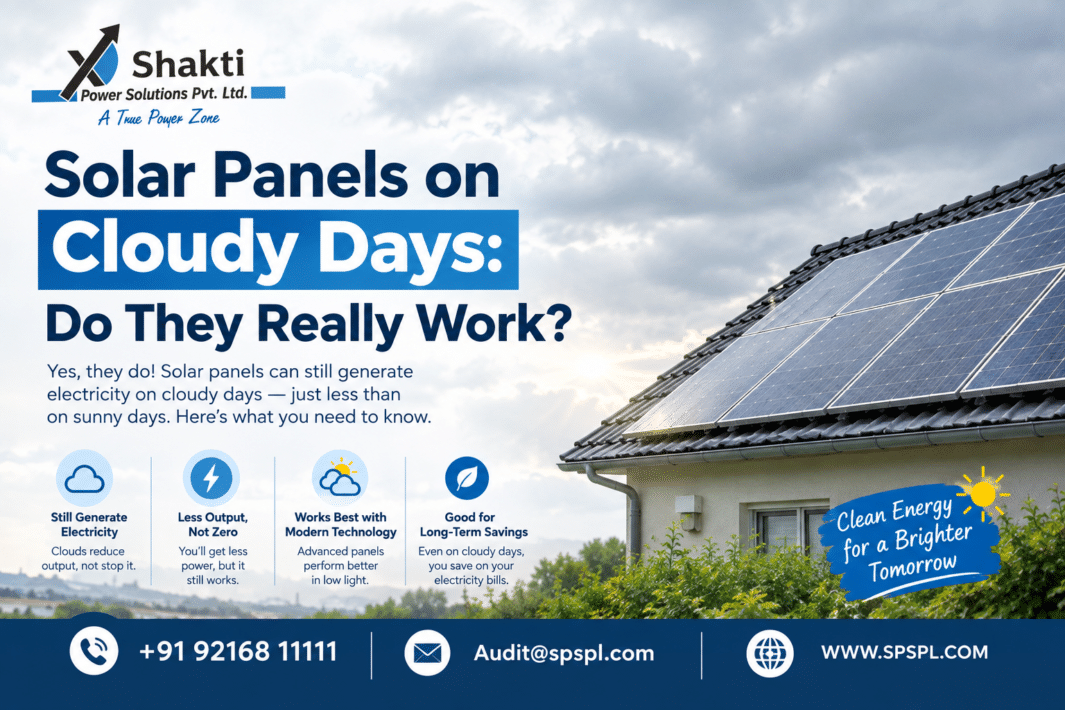
Yes, solar panels on cloudy days can continue to generate electricity.
Photovoltaic panels generate electricity when light reaches their solar cells. That light can arrive directly from the sun or indirectly after being scattered by clouds and particles in the atmosphere.
The U.S. Department of Energy explains that solar radiation reaching the Earth’s surface includes both direct and diffuse components. Clouds can significantly reduce direct sunlight, while diffuse solar radiation can still reach the surface.
This is why an overcast sky does not automatically mean zero solar generation.
However, there is an important distinction.
Solar panels can work on cloudy days, but they generally produce less power than they would under strong, clear-sky conditions.
The actual reduction depends on several factors, including:
- Cloud thickness
- Available solar irradiance
- Time of day
- Season
- Location
- Panel orientation
- Panel tilt
- Shading
- Temperature
- System design
So, when asking Solar Panels on Cloudy Days: Do They Really Work?, the scientifically accurate answer is:
Yes, they work — but their output can be lower when cloud cover reduces available solar radiation.
How Do Solar Panels Generate Electricity Without Direct Sunlight?
To understand Solar Panels on Cloudy Days: Do They Really Work?, it helps to understand the difference between direct and diffuse sunlight.
Direct Sunlight
Direct sunlight travels from the sun toward the solar panel without significant scattering.
On a clear day, solar panels can receive a strong direct component, which can support higher electricity generation.
Diffuse Sunlight
Diffuse sunlight is sunlight that has been scattered by clouds, water vapour, dust, and other particles in the atmosphere.
Even when the sun itself is hidden behind clouds, some scattered light can still reach the solar cells.
That light can contribute to electricity generation.
This is one of the main reasons solar panels on cloudy days do not simply switch off when the sky becomes overcast.
The amount of usable sunlight may be lower, but it is not necessarily absent.
The U.S. Department of Energy describes diffuse radiation as sunlight scattered by atmospheric elements such as clouds, water vapour, and dust.
What Is Solar Irradiance?
One of the most important terms when discussing Solar Panels on Cloudy Days: Do They Really Work? is solar irradiance.
In simple terms, solar irradiance refers to the amount of solar power reaching a particular surface area. It is commonly expressed in watts per square metre (W/m²).
When more solar irradiance reaches a PV module, there is generally more energy available for the solar cells to convert into electricity.
Clouds can reduce irradiance by blocking and scattering sunlight.
Light cloud cover may have a smaller effect, while thick cloud cover can cause a much larger reduction.
However, clouds are not the only factor affecting irradiance.
Solar radiation also changes according to:
- Time of day
- Season
- Geographic location
- Sun position
- Atmospheric conditions
- Panel orientation
- Panel tilt
- Shading
- Weather conditions
The Department of Energy notes that solar radiation varies with location, time of day, season, local landscape, and weather.
This is why judging a solar project by looking at one cloudy day can be misleading.
A proper solar assessment considers the site’s solar resource over a much longer period.
Solar Panels on Cloudy Days: What Happens to Power Output?
The basic principle is simple:
Less available irradiance generally means lower PV output.
Imagine a commercial rooftop on a clear morning.
The solar array may receive strong sunlight and produce substantial power.
Now imagine clouds moving across the same site.
As cloud cover increases, the irradiance reaching the panels can fall. The electrical output can fall with it.
When the clouds move away and more sunlight reaches the array, generation can increase again.
This means solar generation can change throughout the day, particularly when cloud cover is broken or moving.
The Department of Energy also notes that clouds can interfere with solar production and that time of day and seasonal conditions influence how much energy a PV system can produce.
For businesses, this is one reason energy modelling should focus on expected generation over time, rather than assuming that a solar plant will operate at its maximum rated capacity throughout the day.
Rated Solar Capacity vs. Real-World Output
Another important part of understanding Solar Panels on Cloudy Days: Do They Really Work? is knowing the difference between rated capacity and actual electricity generation.
Suppose a solar project has a rated capacity of 1 MW.
It does not mean that the plant will continuously produce 1 MW of electricity every hour.
The rated capacity represents the system’s electrical capacity under specified test conditions.
Actual production changes throughout the day and across the year.
PV module performance ratings are commonly measured under Standard Test Conditions, including irradiance of 1,000 W/m² and a cell temperature of 25°C. Real-world operating conditions are often different.
Actual solar output can be affected by:
- Solar irradiance
- Cloud cover
- Temperature
- Shading
- Panel orientation
- Panel tilt
- Dust and soiling
- Inverter losses
- Electrical losses
- Equipment availability
- Seasonal conditions
So, when evaluating solar panels on cloudy days, it is important not to compare a real operating system directly with its nameplate rating.
For a business, the more useful metric is usually expected energy generation over a month, season, or year.
Does Temperature Affect Solar Panel Performance?
Yes.
Temperature is another factor that influences PV performance.
It may seem logical to assume that hotter weather should always be better for solar because hot days often come with strong sunshine.
But solar cells generally perform better electrically at lower cell temperatures.
As cell temperature increases, voltage generally decreases, which can reduce electrical efficiency.
The Department of Energy notes that PV module ratings are measured under standard test conditions, while actual sunlight intensity and cell temperatures can differ significantly in real-world operation.
This creates an interesting relationship between weather and solar generation.
A cloudy day may have lower irradiance, which reduces available solar energy.
At the same time, cooler conditions can reduce some temperature-related efficiency losses.
That does not mean a cloudy day will normally generate more electricity than a sunny day.
The reduction in available irradiance remains an important factor.
It simply shows why solar performance depends on several variables at the same time.
How Does Shading Affect Solar Panel Performance?
Clouds are not the only source of shading.
Commercial and industrial rooftops may have:
- Water tanks
- HVAC equipment
- Chimneys
- Nearby buildings
- Trees
- Communication equipment
- Other rooftop structures
These objects can cast shadows over parts of a solar array.
Even when most of the roof receives good sunlight, poorly planned panel placement can reduce the performance of affected modules.
For a large commercial or industrial installation, shading analysis should therefore be part of the site assessment.
The Department of Energy identifies shading and other site conditions as factors that can affect PV system production.
This is another reason why simply looking at a rooftop and saying “it gets plenty of sunlight” isn’t enough.
A professional assessment should consider how shadows move across the site during different times of day and throughout the year.
Does Panel Orientation Matter?
Yes.
Panel orientation and tilt can influence how much solar radiation reaches the modules.
The ideal configuration depends on the location, roof structure, available area, system objectives, and other site-specific factors.
For Solar Panels on Cloudy Days: Do They Really Work?, orientation still matters because the amount and direction of available solar radiation can change.
A well-designed system considers:
- Roof orientation
- Panel tilt
- Available installation area
- Local solar resource
- Shading
- Structural limitations
- Electricity consumption patterns
There is no single panel configuration that is automatically ideal for every commercial facility.
The right design should be based on the actual site.
Do Solar Panels Work During Heavy Cloud Cover?
Yes, but the output can be significantly lower.
There is a difference between a partly cloudy sky and heavy, dense cloud cover.
With light or broken clouds, panels can continue receiving direct and diffuse light.
Generation may fluctuate as clouds move across the array.
With thick cloud cover, the amount of solar irradiance reaching the panels can fall substantially.
This means solar panels on cloudy days may continue producing electricity, but actual output depends heavily on the severity of the weather conditions.
It is therefore difficult — and often misleading — to give one fixed percentage for how much production will fall on every cloudy day.
A cloudy day in one location can be very different from a cloudy day somewhere else.
The Department of Energy specifically notes that thick clouds can reduce direct-beam solar radiation substantially, while diffuse radiation remains part of the overall solar resource.
Can Solar Panels Work When It Is Raining?
Yes.
Solar panels can still generate electricity during rain as long as sufficient daylight reaches the solar cells.
However, heavy rainfall is often accompanied by dense cloud cover.
When that cloud cover reduces available irradiance, solar generation will also generally decrease.
Rain itself does not act like an on/off switch for a PV system.
The key factor is still the amount of usable light reaching the modules.
There is also a potential maintenance benefit to rainfall because it may wash away some dust or surface dirt from panels.
However, natural rainfall should not be considered a replacement for appropriate solar system maintenance.
So, when someone asks Solar Panels on Cloudy Days: Do They Really Work?, rain should be considered together with the amount of available sunlight rather than as an independent on/off condition.
What Does Cloudy Weather Mean for Commercial Solar Buyers?
For a homeowner, a cloudy day may simply mean that the electricity generated by the rooftop system is lower than usual.
For an industrial or commercial buyer, the question is bigger.
A solar installation is a long-term investment.
Businesses need to understand how much energy the system can realistically generate throughout the year.
That means looking beyond the panel’s rated capacity.
A proper assessment should consider:
1. Solar Irradiance
How much solar energy is available at the site across different months and seasons?
2. Weather Conditions
How does local weather affect expected solar generation?
3. Shading
Are buildings, trees, or rooftop structures blocking sunlight?
4. Panel Orientation and Tilt
Can the available roof or land area be positioned appropriately?
5. Temperature
How could local operating temperatures affect module performance?
6. System Design
Are the modules, inverters, mounting structures, and electrical components appropriately selected?
7. Expected Energy Yield
How much electricity is the system expected to generate monthly and annually?
This type of analysis gives a business a much more realistic picture of its potential solar investment.
Why Annual Solar Performance Matters More Than One Cloudy Day
One of the biggest mistakes a potential solar buyer can make is judging a project’s viability based on a few sunny or cloudy days.
Solar generation changes naturally throughout the year.
There will be:
- Bright sunny days
- Partly cloudy days
- Overcast days
- Rainy periods
- Seasonal changes
- Shorter winter daylight hours
- Longer summer daylight hours
A well-designed solar project accounts for these variations.
Historical solar resource and site-specific modelling can help estimate expected energy generation over longer periods.
The Department of Energy explains that solar-resource variability can be assessed using time of day, time of year, historical climate data, and other factors when evaluating expected PV performance.
For a commercial buyer, the better question is therefore:
“What is the expected annual energy yield from this site?”
rather than:
“What happens to solar panels on one cloudy day?”
That shift in perspective makes solar planning much more useful for business decision-making.
How Can Businesses Evaluate Solar Performance Before Installation?
Before investing in a commercial or industrial solar system, businesses should carry out a proper site and feasibility assessment.
This can help identify:
- Available installation area
- Solar resource
- Shading risks
- Orientation and tilt
- Potential system capacity
- Expected energy generation
- Site limitations
- Financial considerations
- Long-term performance expectations
One useful starting point is the NREL PVWatts Calculator, which estimates electricity production for grid-connected PV systems using inputs such as location and system configuration. NREL describes PVWatts as a tool for estimating solar PV energy production using relatively simple inputs.
However, a calculator should be treated as an estimate rather than a replacement for a detailed site assessment.
For a commercial or industrial project, actual site conditions, system design, shading, equipment selection, and local weather data all matter.
SPSPL also provides solar solutions for commercial and industrial applications, making a site-specific assessment relevant for businesses evaluating solar.
SPSPL solar panel and rooftop solutions to the relevant SPSPL solar page.
Frequently Asked Questions About Solar Panels on Cloudy Days
Do solar panels work on cloudy days?
Yes. Solar panels on cloudy days can generate electricity because PV modules can use diffuse sunlight as well as direct sunlight.
However, output generally decreases when cloud cover reduces the irradiance reaching the panels.
How much electricity do solar panels produce on cloudy days?
There is no single percentage that applies to every cloudy day.
Output depends on irradiance, cloud thickness, location, panel orientation, shading, temperature, system design, and other operating conditions.
This is why Solar Panels on Cloudy Days: Do They Really Work? cannot be answered using one fixed production percentage.
Do solar panels need direct sunlight?
No.
Solar panels can generate electricity from both direct and diffuse sunlight.
This allows them to continue generating power even when the sun is hidden behind clouds.
Do solar panels work during rain?
Yes.
Solar panels can continue producing electricity during rain if sufficient daylight reaches the modules.
Heavy cloud cover, however, can reduce generation.
Does cloudy weather make solar power ineffective?
Not necessarily.
Cloudy weather can reduce solar output, but it does not automatically make solar power ineffective.
Solar project performance should be evaluated using the site’s solar resource, historical weather conditions, system design, and expected energy yield.
Does temperature affect solar panel output?
Yes.
Solar cell performance changes with temperature.
Higher cell temperatures can reduce electrical efficiency, which is one reason actual PV output differs from laboratory-rated capacity.
Why doesn’t a 1 MW solar plant produce 1 MW all day?
A solar plant’s rated capacity represents its electrical capacity under specified test conditions.
Actual generation changes according to irradiance, weather, temperature, shading, orientation, equipment losses, and time of day.
Can solar panels generate electricity when the sky is completely overcast?
They may continue to generate electricity when diffuse daylight reaches the modules, but output can be substantially lower under dense cloud cover.
The exact production depends on the amount of solar irradiance available at the site.
Final Thoughts
So, Solar Panels on Cloudy Days: Do They Really Work?
Yes.
Solar panels can continue generating electricity under cloudy conditions because photovoltaic modules can use diffuse sunlight as well as direct sunlight.
What changes is the amount of energy available to the system.
Cloudy weather can reduce irradiance, and lower irradiance generally means lower solar output.
At the same time, temperature, shading, panel orientation, tilt, system design, equipment, and location also influence real-world performance.
For industrial and commercial buyers, this is why the right approach is not to judge solar by one cloudy day — or even by the number of sunny days alone.
The better approach is to evaluate the actual site, solar resource, expected energy yield, system design, and long-term performance.
If your business is considering a solar project, a site-specific assessment can help you understand how local conditions may affect expected generation.
Want to know how your site could perform with solar? Explore SPSPL’s solar solutions and discuss your site requirements with the team.
Understanding the numbers before investing can help you make a more informed long-term decision.