
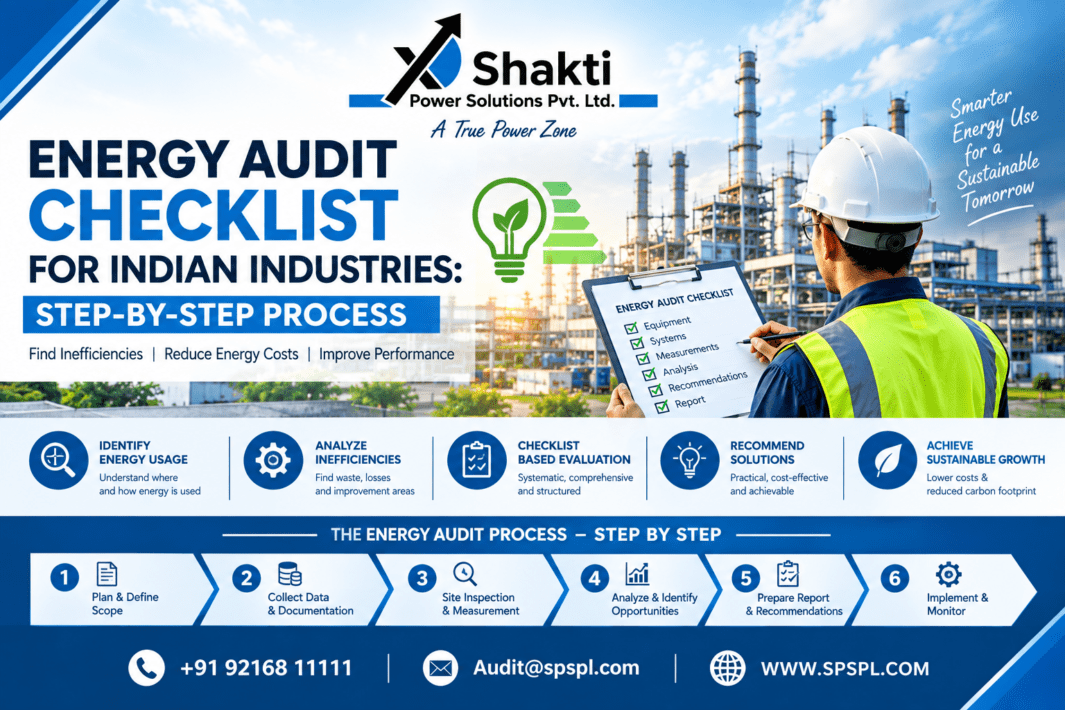
Running a factory efficiently is not only about keeping production moving. Energy costs can have a significant impact on operating expenses, especially in industries that depend heavily on motors, compressors, boilers, furnaces, pumps, HVAC systems, electrical equipment and process heating.
The challenge is that energy losses are not always visible.
A machine may continue to operate normally while consuming more electricity than necessary. A compressed-air system may have leaks that nobody notices. A boiler may be operating with avoidable heat losses. An overloaded transformer, inefficient motor or poor power factor can also increase energy-related costs.
This is where an energy audit checklist for Indian industries becomes useful.
An energy audit provides a systematic way to understand where energy is being consumed, where losses are occurring and where practical opportunities for improvement may exist.
For Indian industries, the process can also be relevant to energy-efficiency requirements and reporting frameworks, particularly for facilities covered under applicable Bureau of Energy Efficiency (BEE) provisions.
In this guide, we will walk through a practical step-by-step energy audit process for factories in India, along with a checklist that plant teams can use before, during and after an audit.
Table of Contents
What Is an Energy Audit?
An energy audit is a systematic assessment of how energy is purchased, distributed and consumed within a facility.
The objective is not simply to collect electricity bills.
A proper industrial energy audit connects energy consumption with actual plant operations. It looks at production levels, operating hours, equipment performance, process conditions and energy losses.
Depending on the scope of the audit, an auditor may examine:
- Electricity consumption
- Fuel consumption
- Production data
- Specific energy consumption
- Motors and drives
- Pumps and fans
- Compressed-air systems
- Boilers and steam systems
- Furnaces and ovens
- HVAC and refrigeration
- Transformers and electrical distribution
- Power factor
- Lighting
- Process equipment
- Waste heat
- Utility systems
The final objective is to identify realistic opportunities that can improve energy performance and potentially reduce operating costs.
Why Do Indian Factories Need an Energy Audit?
Energy is often one of the major operating costs in an industrial facility. Even a small improvement in the efficiency of a large energy-consuming system can become meaningful when the equipment operates for thousands of hours each year.
An audit can help a plant answer questions such as:
Where is most of our energy going?
Which equipment is consuming more energy than expected?
Are there avoidable losses?
Which energy-saving measures should be considered first?
What investment would be required?
What could be the estimated energy and cost savings?
For certain energy-intensive industries, energy audits are also connected with India’s regulatory framework. BEE identifies Designated Consumers under the Energy Conservation framework, and applicable designated consumers have specific energy-management and audit-related obligations.
Therefore, an audit should not be treated only as a cost-cutting exercise. For the relevant facilities, it can also form part of broader energy-efficiency and compliance activities.
Energy Audit Checklist for Indian Industries
Before starting the actual audit, the plant team should prepare the basic information required by the auditor.
Here is a practical checklist.
1. Basic Plant Information
☐ Plant name and location
☐ Industry/sector
☐ Main products manufactured
☐ Installed production capacity
☐ Actual production data
☐ Number of operating shifts
☐ Operating hours per day
☐ Number of working days per year
☐ Major production processes
☐ Plant layout
☐ Major utility systems
2. Energy Consumption Data
☐ Electricity bills
☐ Electricity consumption for the previous 12–24 months
☐ Maximum demand data
☐ Power factor information
☐ Diesel consumption
☐ Furnace oil consumption, if applicable
☐ Natural gas consumption, if applicable
☐ Coal consumption, if applicable
☐ LPG consumption, if applicable
☐ Other fuel consumption
☐ Renewable energy generation, if applicable
3. Production Information
☐ Monthly production data
☐ Product-wise production
☐ Capacity utilisation
☐ Production losses or downtime
☐ Major changes in production during the audit period
☐ Specific energy consumption data, where available
4. Electrical System
☐ Incoming supply details
☐ Transformer capacity
☐ Transformer loading
☐ Main LT/HT panels
☐ Distribution system
☐ Motor inventory
☐ Motor loading
☐ Variable frequency drives
☐ Power factor correction equipment
☐ Capacitor bank condition
☐ Harmonic-related observations, where relevant
☐ Lighting system
5. Thermal and Process Systems
☐ Boiler details
☐ Furnace details
☐ Steam generation and distribution
☐ Steam traps
☐ Insulation condition
☐ Flue-gas temperature
☐ Combustion conditions
☐ Waste heat recovery opportunities
☐ Hot-water systems
☐ Process heating requirements
6. Utility Systems
☐ Compressed-air system
☐ Air compressors
☐ Compressor loading/unloading pattern
☐ Air pressure requirements
☐ Compressed-air leakage
☐ Pumps
☐ Fans
☐ Cooling towers
☐ Chillers
☐ HVAC systems
☐ Refrigeration systems
☐ Water pumping systems
This checklist can be expanded according to the type of industry and the audit scope.
Step-by-Step Energy Audit Process for Factories
A professional audit should follow a structured process rather than simply walking around the plant and collecting equipment readings.
Step 1: Define the Audit Scope
The first step is to clearly define what the audit will cover.
For example, an audit may cover the entire factory or focus on selected systems such as:
- Electrical systems
- Compressed air
- Boiler and steam
- Furnace
- HVAC
- Chiller
- Pumping systems
- Production processes
The auditor and plant management should agree on the audit boundaries, objectives, available data and expected deliverables.
A clearly defined scope prevents confusion later.
Step 2: Collect Historical Energy Data
Before visiting the plant, historical data should be collected.
Ideally, the audit team should examine energy consumption over a sufficiently representative period rather than relying on a single month’s bill.
Useful information includes:
- Electricity units consumed
- Maximum demand
- Electricity cost
- Fuel consumption
- Production quantity
- Operating hours
- Seasonal variations
The auditor can then compare energy consumption with production to identify trends.
For example, if production remains relatively stable but energy consumption increases significantly, it may indicate an operational or equipment-related issue that deserves further investigation.
Step 3: Conduct a Preliminary Plant Walk-Through
The next stage is a physical inspection of the facility.
The auditor should understand how energy enters the plant and how it moves through different systems.
A typical walk-through may cover:
Incoming power → Transformer → Distribution → Motors → Production equipment
and
Fuel → Boiler/Furnace → Steam/Heat → Production Process
During the walk-through, the auditor should note equipment condition, operating practices, obvious losses, unusual sounds, temperature differences, leaks and other visible indicators.
Sometimes a simple plant walk-through can reveal opportunities that are not obvious from electricity bills.
Step 4: Identify Major Energy-Consuming Systems
Not every piece of equipment deserves the same level of attention.
The audit should identify the systems responsible for a significant portion of total energy consumption.
Depending on the industry, these may include:
- Motors
- Compressors
- Boilers
- Furnaces
- Chillers
- Cooling towers
- Pumps
- Fans
- HVAC
- Process heating systems
Once major energy consumers are identified, measurements and analysis can be focused where they are most useful.
Step 5: Measure and Monitor Equipment
This is one of the most important stages of an industrial energy and power quality audit, because actual operating data helps identify performance issues that may not be visible from energy bills alone.
Instead of relying only on nameplate ratings or theoretical values, actual operating conditions should be measured wherever appropriate.
Depending on the equipment, measurements may include:
Electrical Measurements
- Voltage
- Current
- Power
- Power factor
- Frequency
- Maximum demand
- Load profile
Motor Measurements
- Motor loading
- Running current
- Operating hours
- Efficiency-related observations
- Drive operation
Compressed-Air Measurements
- Pressure
- Flow
- Compressor loading
- Unloading pattern
- Leakage
- Specific power consumption
Boiler and Thermal Measurements
- Fuel consumption
- Steam generation
- Flue-gas temperature
- Combustion parameters
- Feedwater temperature
- Blowdown
- Insulation condition
The exact measurements depend on the audit scope and equipment.
Step 6: Analyse Energy Performance
Once the data has been collected, it needs to be converted into useful information.
One important metric is Specific Energy Consumption (SEC).
In simple terms, SEC represents the amount of energy used to produce a unit of output.
For example:
SEC = Energy Consumption ÷ Production Output
Tracking SEC over time can help the plant understand whether energy performance is improving or deteriorating.
However, SEC should be interpreted carefully. Changes in product mix, production volume, operating conditions and process requirements can affect energy consumption.
For this reason, an experienced auditor should consider the operational context rather than looking at one number in isolation.
Step 7: Identify Energy-Saving Opportunities
After analysing the data, the auditor can identify potential Energy Conservation Measures (ECMs).
Some common opportunities in Indian industrial facilities include:
Electrical Systems
- Optimising transformer loading
- Improving power factor where required
- Replacing inefficient equipment
- Optimising motor operation
- Using variable frequency drives where technically suitable
Compressed Air
- Repairing air leaks
- Optimising pressure
- Improving compressor sequencing
- Reducing unnecessary compressed-air use
- Reviewing compressor loading patterns
Boiler and Steam
- Improving combustion
- Repairing steam leaks
- Improving insulation
- Maintaining steam traps
- Optimising blowdown
- Exploring waste-heat recovery where feasible
Pumping Systems
- Optimising pump operation
- Avoiding unnecessary throttling
- Reviewing pump sizing
- Using variable-speed control where appropriate
HVAC and Cooling
- Improving operating schedules
- Cleaning heat-transfer surfaces
- Optimising chilled-water systems
- Maintaining cooling towers
- Reviewing set points
The important point is that an energy-saving opportunity should be technically suitable for the plant. Not every measure is appropriate for every facility.
Step 8: Calculate Potential Savings and Payback
Identifying an opportunity is only the beginning.
Plant management generally needs to understand:
- Estimated energy savings
- Estimated annual cost savings
- Required investment
- Simple payback period
- Operational impact
- Maintenance requirements
- Implementation difficulty
For example, replacing equipment may provide energy savings but require capital investment.
On the other hand, correcting compressed-air leakage or changing operating practices may require comparatively little investment.
This allows the plant to separate opportunities into categories such as:
No-cost / Low-cost measures
Medium-investment measures
Capital-intensive projects
This makes the audit report much more practical for decision-making.
Step 9: Prioritise Recommendations
A long list of recommendations is not necessarily a useful audit report.
Recommendations should be prioritised according to factors such as:
- Energy-saving potential
- Cost savings
- Investment required
- Payback
- Technical feasibility
- Operational impact
- Maintenance requirements
A plant may choose to implement quick wins first and then plan larger projects through a phased energy-efficiency programme.
Step 10: Prepare the Energy Audit Report
The final report should present the findings in a way that plant management and technical teams can actually use.
A typical report may include:
- Executive summary
- Plant and process overview
- Energy consumption profile
- Production information
- Utility analysis
- Equipment performance
- Measurements and observations
- Energy-saving opportunities
- Estimated energy savings
- Estimated cost savings
- Investment requirements
- Payback analysis
- Recommended actions
- Implementation priorities
For facilities subject to specific BEE requirements, the report and documentation should also follow the applicable regulatory requirements and prescribed formats.
Free Energy Audit Checklist for Factories
If you are preparing for an industrial energy audit, you can use the following quick checklist before the auditor arrives:
Before the Audit
☐ Collect 12–24 months of electricity bills
☐ Collect fuel consumption records
☐ Prepare monthly production data
☐ Prepare plant layout
☐ List major electrical equipment
☐ List boilers and furnaces
☐ Prepare compressor details
☐ Prepare pump and fan details
☐ Collect equipment specifications
☐ Keep previous audit reports available
☐ Identify major operational changes
☐ Nominate a plant representative
During the Audit
☐ Conduct plant walk-through
☐ Record operating conditions
☐ Measure major energy-consuming equipment
☐ Check compressed-air leakage
☐ Check steam and thermal losses
☐ Review electrical loading
☐ Review motor operation
☐ Check lighting systems
☐ Review HVAC/chiller operation
☐ Discuss operational practices with plant operators
After the Audit
☐ Review identified energy-saving opportunities
☐ Check estimated savings
☐ Review investment requirements
☐ Prioritise quick wins
☐ Assign responsible departments
☐ Set implementation timelines
☐ Establish monitoring parameters
☐ Track actual savings after implementation
Common Mistakes to Avoid During an Energy Audit
An energy audit can lose its value if the exercise becomes purely paperwork-driven.
Here are some common mistakes:
1. Looking Only at Electricity Bills
Bills show how much energy was purchased, but they do not explain exactly where energy is being lost.
2. Ignoring Production Data
Energy consumption should be viewed alongside production. Otherwise, comparing two months can produce misleading conclusions.
3. Measuring Only One Operating Condition
Equipment performance can change with load, shift, production level and operating conditions. Measurements should represent normal operation wherever possible.
4. Giving Generic Recommendations
Recommendations such as “replace inefficient equipment” are not enough. A useful audit should explain the opportunity, expected benefit and implementation considerations.
5. Ignoring Low-Cost Opportunities
Not every energy-saving measure requires a major capital investment. Operational improvements, maintenance and leakage control can also matter.
6. Not Following Up
The value of an audit is ultimately realised when suitable recommendations are implemented and their results are monitored.
How Often Should an Industry Conduct an Energy Audit?
There is no single frequency that applies identically to every industrial facility.
The appropriate frequency depends on factors such as the industry, energy consumption, regulatory requirements, plant changes and the purpose of the audit.
For facilities covered by applicable BEE requirements, the audit frequency and compliance obligations should be checked against the latest applicable regulations and notifications.
For other facilities, periodic energy audits can still be useful when there are major changes in production, equipment, energy prices, operating conditions or energy performance.
Energy Audit vs Energy Management
An energy audit and power quality audit is not the same thing as an ongoing energy-management programme.
An audit provides a detailed assessment of energy use and identifies opportunities.
Energy management is the continuous process of:
Measure → Analyse → Improve → Monitor → Repeat
This is why the real benefit of an audit comes from implementation and follow-up.
A plant that performs an audit but never implements or monitors the recommendations may miss much of the potential value.
Final Thoughts
An effective energy audit checklist gives an industrial plant a structured starting point for understanding its energy performance.
From collecting historical consumption data to inspecting equipment, taking measurements, analysing specific energy consumption and identifying practical energy-saving opportunities, each step contributes to a clearer picture of how energy is being used.
For Indian factories, the process should also take into account the applicable BEE requirements and the specific characteristics of the plant.
Most importantly, an energy audit should not end with a report sitting on a shelf.
The real objective is to turn audit findings into practical improvements — whether that means fixing compressed-air leaks, improving boiler performance, optimising motors and pumps, reducing electrical losses or implementing larger energy-efficiency projects.
If your plant is planning an energy audit, start by collecting your energy, production and equipment data. A well-prepared plant makes the audit process more efficient and helps the auditor focus on the areas where meaningful opportunities may exist.
Need professional energy audit support for your industrial facility? Contact SPSPL to discuss your plant’s energy audit requirements.